
What the 2026 Economic Outlook Actually Means for CRE in Central Florida
March, 2026
Every year, the economic forecast comes with the same caveat: uncertainty. But 2026 is delivering a specific kind of uncertainty that CRE advisors and their clients cannot afford to sit on. Interest rates are staying elevated longer than most projected, tariffs have climbed to levels not seen since the 1930s, and GDP growth is grinding along rather than running. For Central Florida commercial real estate owners, tenants, and investors, these conditions have direct implications for decisions being made right now.
FCPG team members attended the CORFAC International Spring Conference in New Orleans, where Dr. Loren C. Scott presented his 2026 economic outlook, which is where the following information has been derived from.
The Interest Rate Reality
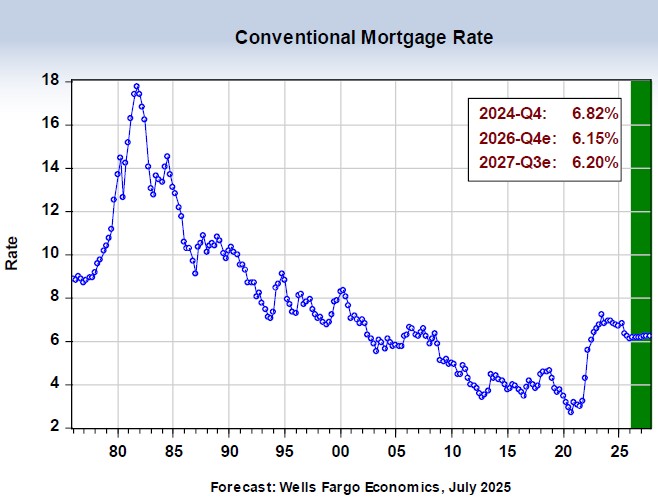
Wells Fargo Economics projects the 30-year conventional mortgage rate at 6.15% by Q4 2026 and 6.20% by Q3 2027. ¹ The structural reason is straightforward: a basic rate of 3% plus an inflationary premium of 3% produces a 6% floor. That floor does not move unless inflation moves.
For buyers and tenants weighing ownership against leasing, this changes the math. Debt service at 6% is materially different from debt service at 4%, and that difference compounds across a multi-year hold.
Dr. Scott made one point worth repeating: Powell does not control mortgage rates by changing the Fed rate. The 10-year Treasury, inflation expectations, and bond market dynamics drive long-term rates. That is why two rate cuts projected in the first half of 2026 do not automatically translate into meaningful mortgage relief. ¹
Dr. Loren C. Scott
Dr. Loren C. Scott
Tariffs and the Construction Cost Problem
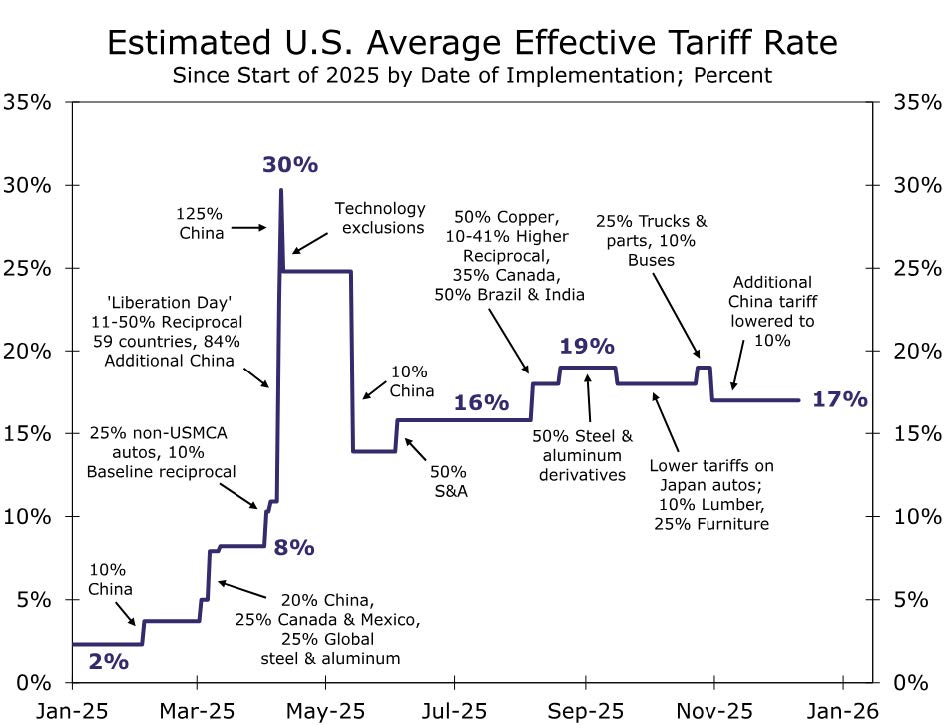
According to a Wells Fargo trade-weighted average estimate presented by Dr. Scott, the U.S. effective tariff rate rose from approximately 2% in early 2025 to a peak of 30% during Liberation Day in April 2025, before settling to approximately 17% as of early 2026 following the Supreme Court ruling that struck down IEEPA-based tariffs. ¹ The last time U.S. effective tariff rates were anywhere near this level was the 1930s. ¹
The CRE consequence is direct: construction materials, HVAC systems, steel, and copper are all subject to supply chain disruption and cost inflation that moves through to developers, landlords, and tenants.
Tenants in the market for new construction or significant buildout should treat cost and timeline assumptions from 12 months ago as outdated. Investors evaluating value-add properties need renovation budgets stress-tested against current material costs, not historical baselines.
GDP Growth: Steady, Not Explosive
The consensus RGDP forecast as of late February 2026 runs at approximately 2.0 to 2.2% annualized across 2026 and into 2027. Wells Fargo projected a stronger Q1 2026 at 3.6% before moderating to that 2.0 to 2.3% range through year-end. ¹ Q4 2025 actual GDP growth came in at 1.4% annualized, well below Q3’s 4.4%, largely due to a government shutdown effect and softening consumer spending. The BBB tax package passed in late 2025 is expected to add approximately 1.2 percentage points to RGDP in the first half of 2026. ¹
This is a stabilization environment, not a contraction. It is also not a growth cycle that supports speculative expansion or loose underwriting. Tenants will be deliberate about expansion decisions. Lease renewals will get more scrutiny than they did in 2021 or 2022. For landlords, occupancy strategy, rent positioning, and proactive tenant communication are where the work happens now.

Leasing vs. Buying in This Environment
The buy-versus-lease analysis looks different in 2026 than it did two years ago. Elevated borrowing costs have narrowed the economic case for ownership, particularly for smaller businesses and those without long-term certainty about their space needs. A well-structured lease with flexibility provisions may offer better risk-adjusted outcomes than ownership at current rates for many users.
For well-capitalized buyers and investors, opportunities exist. Values have adjusted in certain segments, competition for quality assets has moderated, and patient capital with a multi-year hold horizon is in a better position than it was at the peak of rate cycle uncertainty.

The Central Florida Context
Central Florida’s fundamentals are strong relative to national peers. Population growth, industrial demand driven by port and logistics activity, and retail performance in established trade areas give the market some buffer against the macro headwinds. But no submarket is fully removed from interest rate pressure, construction cost inflation, or the downstream effects of tariff uncertainty on tenant expansion decisions.
The CRE advisors adding value right now are the ones running real analysis: stress-testing assumptions, modeling scenarios, and helping clients make decisions grounded in current conditions rather than the market of two or three years ago.
Navigating the Market with the Right Advisor
At FCPG, our brokerage and property management teams work together so clients have a full picture of their position. Whether you are a tenant evaluating a location, an owner approaching a lease expiration or refinancing event, or an investor timing an acquisition or disposition, the economic context is the starting point. Contact FCPG to discuss how current conditions affect your specific situation.